

Author: Nanuka Kokhodze
“Don’t interfere in family matters,” “It’s too private,” “Whose business is it when a husband and wife argue at home?” — how many times have you heard similar phrases when it comes to women’s rights and violence against women?
Such conversations are not new, and the problem stems from an idealized perception that was laid down in bourgeois public discussions as early as the 18th century.
What is private and what is public? Why are women’s problems excluded from the public sphere and why are they perceived as private? Why does the public sphere belong dominantly to privileged groups? Discussions are actively underway in academic spaces to answer these questions.
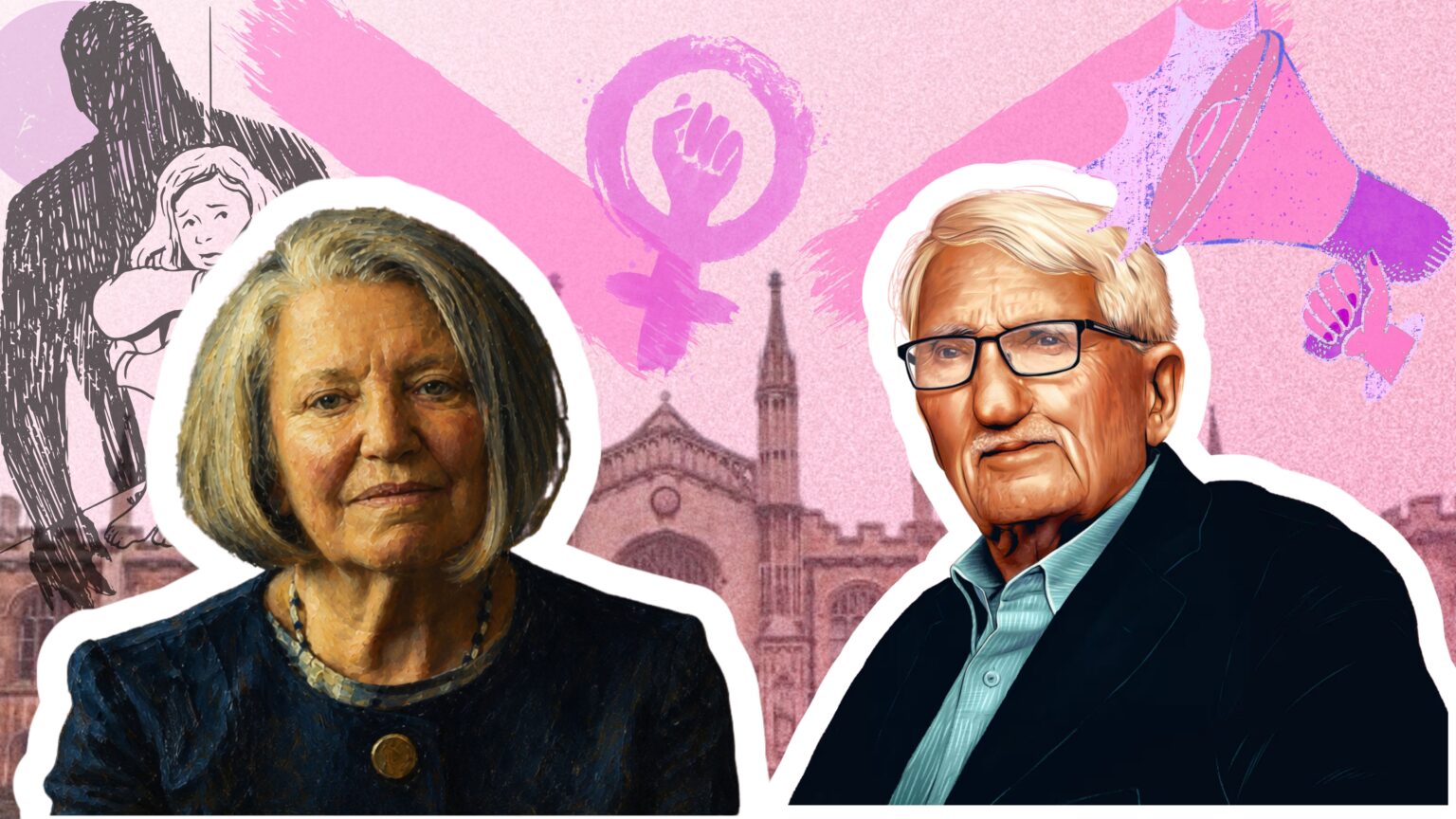
We will examine the debate surrounding the issue through the theoretical lenses of two authors, Nancy Fraser and Jürgen Habermas.
Jürgen Habermas, born in 1929, was a prominent German sociologist and philosopher who became known for his theory of communicative rationality and the concept of the "public sphere." His 1962 work "The Structural Transformation of the Public Sphere" is considered a foundational theory of democracy and civic discourse.
Nancy Fraser (born 1947) is a famous American philosopher, social theorist, and feminist, and is a professor of philosophy and political science at the New School for Social Research in New York City. Her work is primarily focused on the critique of contemporary capitalism and structural injustice, but she also actively discusses issues of class inequality and identity politics. Fraser echoes Habermas's work in her 1990 book "Rethinking the Public Sphere. "
The Public Sphere and Superficial Equality
As Habermas explains, the public sphere is an area where debates are held independently of the state, economic factors, and family structures. Here, people speak as equals — without any past, discussing common challenges, and forming public opinion.
Such spaces prioritize open discussion, rational debate, and equal participation.
It seems like an ideal picture, doesn’t it? A place for everyone, regardless of external factors, on an equal footing. However, the critique of feminist theorists shows that the classical public sphere was from the beginning a masculine, class-based, and exclusive project, without which the creation of a modern, egalitarian democracy is virtually impossible.
According to Jürgen Habermas, the origins of modern democratic discourse appear in 17th and 18th century Western Europe, in Britain, France, and Germany. It was during this era that the so-called bourgeois public sphere was formed alongside the absolutist monarchy.
Interestingly, this field initially began as literary criticism. People would gather to discuss new novels and texts, but over time, critical discourse also found its way into the political arena.
London coffeehouses, Parisian salons, periodicals, and print media became the main locations and instruments for shaping public opinion. Through these institutions, a kind of bridge was created between the state and the private sphere, the purpose of which was to control the actions of the government through the power of “public opinion” and rational criticism.
For rational debate to work in such spaces, it was necessary for participants to temporarily forget their own social status, privileges, or differences and treat each other as equals — what Habermas calls the “bracketing” of inequality.
Consequently, the main thing in the discussion was not who was speaking, but how strong and logical the argument was. Social, class, or gender inequality was considered a “private issue” that the citizen left outside before entering the public sphere. Accordingly, the social background that accompanies each citizen continuously was ignored.
As later feminist theorists, especially Nancy Fraser, showed, simply forgetting about inequality, “bracketing it” and pretending to be equal, actually reinforced the privilege of dominant groups.
No matter how much external factors were ignored, the end result was still a reality where the public sphere belonged only to educated, wealthy, bourgeois men.
This stemmed from the fact that debates about social inequality, even without direct discussion, still manifested themselves in language, speech forms, and invisible barriers that failed to recognize women and underprivileged classes as full participants.
For Habermas, a unified public sphere was an ideal, and its dissolution, the existence of other spaces for discussion outside it, was considered a regression. However, in reality, in order for women, minorities, including workers, representatives of different races, and queer people to fully participate in the discussion, it was necessary to create an alternative space, which Fraser calls a “subaltern counter-public sphere.”
People who, due to existing social factors, are excluded from the dominant “public sphere” create and disseminate different discussions (counter-discourses) in similar spaces, which allow them to discuss their own interests and needs.
An example of this is the American feminist movement of the late 20th century, with its magazines, publishing houses, bookstores, film and video distribution networks, lecture series, research centers, festivals, and gathering places. It was in such spaces that terms such as “sexism,” “sexual harassment,” and “marital, date, and acquaintance rape” emerged to describe social realities.
Until non-dominant groups have their own space, they do not have their own language to express oppression.
For example, before the term “sexual harassment” was widely used, violent or degrading behavior by a man at work was considered “just joking” or “flirting.” Feminist counter-publicity was able to create a language that would give this behavior a name.
It is in these examples that one of Fraser’s main criticisms of Habermas is hidden. In Habermas’s idea, there is a unified, neutral public language and sphere, while Fraser shows us that language belonged only to dominant groups.
It is noteworthy that Habermas himself later, in his 1992 work “Between Facts and Norms,” partially took this criticism into account and presented the public sphere as a more plural, differentiated arena, although this still did not mean full agreement with Fraser’s concept of subaltern counter-publicity.
Counter-public spheres, on the other hand, were not created for isolation. Their purpose was to create a safe space for discussion and, at the same time, to create a kind of idea generation place from which marginalized groups with official ideas and demands could emerge into the larger public sphere and begin to fight to change the agenda of the entire society.
This is how problems considered private emerged in the public arena.
At the Crossroads of “Private” and “Public”
The question may arise: “What is private is still private, so why should family problems be discussed publicly?” It is precisely these questions that lead to the widespread phrases voiced in the introduction to the article.
Nancy Fraser writes that if a problem is viewed as “personal,” it automatically loses political weight. Accordingly, if domestic violence against women is packaged with labels such as “personal” and “family matter,” public discussion of these issues will diminish, and reality will become increasingly brutal for women.
This is not just a theoretical idea — it directly determines how the state deals with domestic violence issues in practice. When the problem is packaged as a “private matter,” it is less talked about, and consequently, there is less public pressure to fix it, which, in turn, translates into fewer resources and political will.
It is this assumption that causes the state to view the problem not as a systemic injustice, but as a private case, which directly leads to the disruption of legal response and the weakening of protective mechanisms.
This is where theory and reality intersect — the more violence remains in the “private sphere,” the more institutional responsibility diminishes.
As an example of this, we can consider the 2025 report of the Public Defender of Georgia.
According to the report, the human rights situation of women in the country requires special attention.
However, the rate of all major protective mechanisms related to domestic violence is decreasing year by year:
According to the report, the protective mechanisms themselves are also weak, with electronic surveillance used in only 37 cases, and only 6 people received compensation for violence.
There are not enough shelters and crisis centers in the country.
Until feminists around the world began to speak out from their own spaces, violence against women, caregiving, and reproductive labor remained behind closed doors. As a result, the boundaries between public and private are not natural boundaries but constantly contested political battlegrounds — only by talking about such issues too many times, repeatedly, and endlessly can we determine what becomes a shared concern for society.
The current situation in Georgia is an illustration of exactly this – the oppression of women, doomed to “privacy”, requires constant “publicity”.
However, it should also be noted that public discussion of a problem alone is not the end and often fails to achieve a final result. In traditional theory, the public sphere is strictly separated from the state, meaning that citizens can only express their opinions, while decision-making remains in the hands of elites and privileged groups.
To get out of this dead end, Fraser divides the public sphere into two parts.
To what extent is this transition actually taking place in the Georgian context? The data from the Public Defender’s report make the answer more worrying than encouraging; the number of protection orders, initiation of criminal prosecutions, and investigations are decreasing. Protests and public outrage exist, but the institutional response is weakening, so it can be said that the process is stuck at the “weak publicity” stage — the voice is heard, but it cannot be transformed into law and practice.
Fraser’s main point is simple: True democracy does not just mean giving women and oppressed groups a “right of speech” — democracy works when people have real control over their own daily lives. Democracy is not just talk. It begins when “private” problems become the concern of all; when the voices of the people, not of individuals, are heard in “powerful public spheres.”
Why Are We Talking About Theorists Today?
Why are we talking about criticism that was discussed years ago today? The answer is simple — the problem is still clearly present, and Georgian reality, including not only women’s movements, but also various groups united in the ongoing protest, independent media, are actively creating counter-public spheres.
When institutional politics no longer responds to people’s real fears and concerns, civil discourse and resistance shift from traditional political offices to other arenas. This is exemplified by the numerous protest initiatives that have emerged in Georgian reality, be it lecture series, theatrical or musical manifestos, protest marches of various kinds, and many others.
In these processes, cultural and media spaces directly serve the function of a subaltern counter-public. They create spaces for silenced voices and become the main instruments for voicing problems.
As Nancy Fraser’s critique shows, social equality cannot be achieved by simply ignoring inequality or by confining discussion to a single, elite space. Democratic processes survive precisely through the existence of multiple, alternative spheres, where different social groups, through different mediators, manage to “publicly” rethink and bring their “private” experiences onto the agenda.
Accordingly, the main challenge of the modern public sphere is not to erase differences, but to understand the extent to which public discourse manages to be truly inclusive and to what extent public opinion reflects the real needs of all groups in society.
That is why the answer to the question, “Whose business is family?” is simple: while personal experience is related to oppression and injustice, it is never a story confined to the walls of just one family — it is a common societal challenge, bringing it into the public sphere is the first and necessary step for any democratic change.