

► Note: This article is intended for general education purposes. Bodies, medical history, and medications vary greatly from person to person. Consult your doctor to determine the best method for you and to use it safely.
What Is (And Is Not) Hormonal Contraception?
Hormonal contraception is a group of birth control methods that use hormones to make pregnancy much less likely. It doesn’t “turn off” your body’s reproductive function. It’s more accurate to think of it as changing the body’s signals and conditions in a way that makes it more difficult for fertilization and pregnancy to occur.
There are two broad categories of hormonal contraception:
- Combined hormonal contraception, which contains estrogen and progestin.
- Progestin-only methods (without estrogen).
Although hormonal contraceptive methods look different, they mostly prevent pregnancy through the same basic mechanisms: for example, they reduce the likelihood of ovulation (the release of an egg), make it more difficult for sperm to move through the cervix, and change the lining of the uterus so that it is “less favorable” for implantation. The specific combination of effects varies depending on the method used, but the goal is the same: to reduce the chance of pregnancy.
It is important to remember that hormonal contraception is designed to prevent pregnancy , not to protect against infections. Most contraceptive methods do not protect against sexually transmitted infections (STIs). If you want to protect against STIs, use condoms with hormonal or other contraceptives.
► Access to contraception is not just a matter of “personal preference.” It upholds the right of a person to decide freely and responsibly when and whether to have children.
Main Types of Hormonal Contraception
Most people don’t choose contraception by memorizing the names of hormones. The choice often depends on how much effort a particular form of contraception requires and how well it fits into a person’s daily life.
That’s why the easiest way to understand hormonal contraceptive methods is to divide them by their routine.
Non-Routine Options
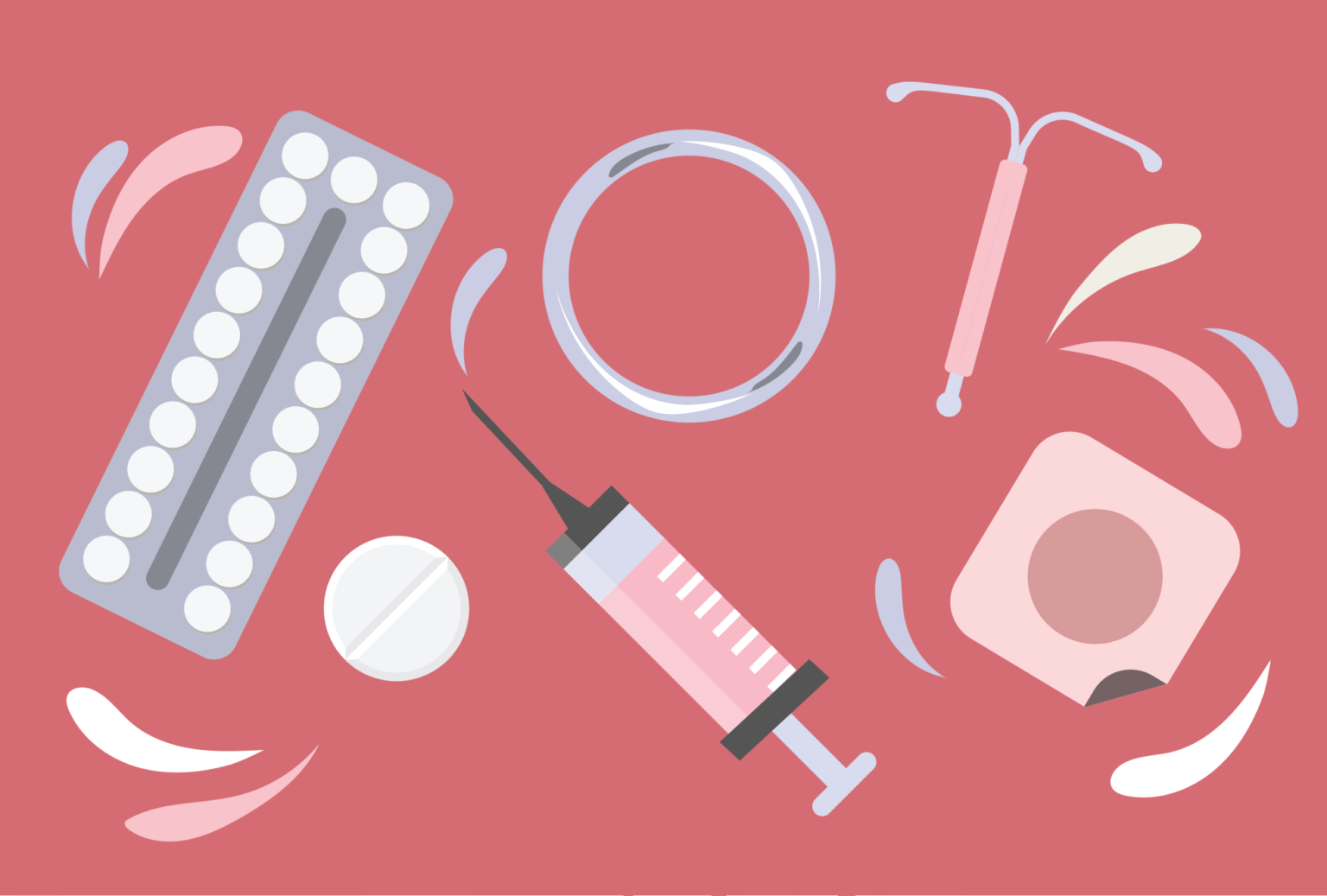
These options are sometimes called long-acting reversible contraception (LARC). The idea is simple: once the method is initially used, it continues to work without daily intervention, which is reassuring for many. These options include:
- Intrauterine device (IUD) — A small T-shaped device that a doctor inserts into the uterus. It releases a very small amount of progestin locally over time. It remains effective for years — typically remaining in the uterus for 3 to 8 years (depending on the device).
- An implant is a small stick that a doctor places under the skin of the upper arm. It releases progestin evenly and steadily for about 3 years.
► Practical note: Such methods are often very effective in practice, largely because they are not as dependent on memory and routine as other, daily/weekly methods.
Routine Options
These methods also work well, but require the development of a repetitive habit, whether it’s every day, every week, every month, or every few months. People often choose these methods when they want more direct control over whether or not they have contraception or prefer not to have a device inserted into their body. These options include:
- Birth control pills — which can be either a combination pill (estrogen + progestin) or a progestin-only pill. The pill is often chosen because it is familiar, confidential, and easy to start/stop. The trade-off is that the pill is more routine-dependent because it needs to be taken at the same time every month.
- Patch — A skin patch that releases estrogen + progestin. Many people like it because it replaces a daily routine with a less frequent routine and does not require taking a pill. A new patch needs to be applied every week for three weeks. On the fourth week, the patch is removed to allow menstruation to occur.
- Vaginal ring — a flexible ring that is inserted into the vagina and releases estrogen + progestin. Often chosen because it is unnoticeable and does not require daily maintenance. The ring is worn for 3 weeks, and on the fourth week it must be removed to allow menstruation to begin, after which a new ring is used.
- Injection — A progestin injection that is given every three months. It can be given either independently or by a doctor.
► Some methods contain estrogen (for example, combination pills, patch, ring), while others do not (implant, injection, hormonal IUD, progestin-only pill). This is important because estrogen is not a good choice for everyone. Talk to your doctor to find out what you need.
Effectiveness of Forms of Contraception
When discussing the effectiveness of hormonal contraception, public health sources often talk about typical use — that is, how well a method works when it is not taken perfectly every time. This includes situations such as missing a pill, not filling a prescription on time, or “postponing” the method due to inattention or other reasons. For example:
- Non-routine methods (such as implants and hormonal IUDs) have very low “failure” rates under typical use. Simply put: they are often reliable because they do not depend on daily habits. The effectiveness rate is over 99%.
- Routine-based methods (pill/patch/ring/injection) are still good options, but their effectiveness in typical use is reduced largely because they rely on human consistency. According to the US Centers for Disease Control and Prevention , in typical use, the pill/patch/ring is in the same group and has an effectiveness of 93%, while the injection is 96%.
► If you don’t want to worry about contraception every day, non-routine options are the most reliable choice. But if you want more control and the ability to easily stop taking contraception if you want, routine options may be more suitable for you.
What Does Hormonal Contraception Change in the Body?
People often think that the only function of hormonal contraception is to prevent pregnancy. However, because these methods work by changing reproductive hormones and “signals,” it’s natural to sometimes notice changes in your bleeding, cramping, skin, and sometimes even mood. This doesn’t automatically mean that something is “wrong.” Most of the time, it’s just your body adjusting to the new hormonal regime.
Simply put, the menstrual cycle is regulated by hormones that rise and fall in the body in a rhythmic manner. Hormonal contraception does not “cancel” this biological process, but depending on the method and the hormones used (combined or progestin-only), it changes certain parts of this rhythm.
Why Are Bleeding Changes Common?
Many hormonal methods reduce the likelihood that the lining of the uterus will build up in the same way as it would during a normal menstrual cycle. This is why some people who take hormonal contraception have:
- Lighter bleeding;
- Less painful menstruation;
- More regular bleeding;
- Spotting, especially at the beginning;
- Or sometimes there is no bleeding at all.
This is one of the most common “surprises,” especially for those who were taught that monthly bleeding is always necessary. With many hormonal contraceptives, monthly bleeding is no longer the same biological need as in the natural cycle, because the hormonal patterns are different this time.
Combined or Progestin Only?
To summarize, the overall picture is as follows:
- Combination methods (estrogen + progestin) create more predictable bleeding for many people because estrogen often helps to “stabilize” the lining of the uterus.
- Progestin-only methods are more likely to cause irregular spotting in some people, especially in the beginning, because the lining may thin or otherwise become “unstable.”
► However, these are general trends, not guarantees. The human body is very “creative” and different people may react differently to these methods. If the bleeding changes are severe, last a long time, or worry you, consult a doctor.
Myths About Hormonal Contraception
Hormonal contraception is a topic that raises many questions and fears, and misconceptions spread quickly. Below, we’ll list the most common myths and contrast them with the facts.
Myth 1: “Hormonal contraception causes infertility”
Reality: Modern contraceptives are designed to prevent pregnancy only during the period of use, and they do not cause long-term infertility . The World Health Organization (WHO) explicitly states that modern contraceptive methods do not cause infertility.
► One important nuance: Some methods can temporarily delay how quickly fertility returns after stopping birth control — especially progestin injections. This is not infertility, it just means that for some people, the return to normal cycles is slower.
Myth 2: “You have to bleed every month, otherwise your body will pool up”
Reality: When using hormonal contraception, bleeding patterns can change — including becoming very light or stopping altogether — and this is not automatically dangerous. The American College of Obstetricians and Gynecologists notes that it may be safe to skip a period when using some methods (such as the pill or the ring).
► If bleeding changes are intense, confusing, or frightening, it is best to consult a doctor.
Myth 3: “Birth control pills always cause weight gain”
Reality: Weight changes after using hormonal contraception are often reported by people, but scientific evidence does not show a uniform, inevitable effect for everyone. The UK NHS notes that while people do report weight changes, there is no strong evidence to suggest that hormonal contraception is the cause in all cases.
Studies on progestin-only methods suggest that if weight gain occurs, it is on average small and does not affect everyone.
► If weight change is a significant factor for you, talk to your doctor about which contraceptive would be most suitable for you.
Myth 4: “Antibiotics cancel out the effects of hormonal contraception”
Reality: Using antibiotics with birth control pills is generally not a problem. There is a risk of reduced effectiveness with certain medications, such as rifampin/rifabutin (rifamycins), which can lower hormone levels and make some hormonal methods less reliable.
► If you are starting a new medication or supplement, tell your doctor that you are using hormonal contraception so they can check for interactions.
Myth 5: “Hormonal contraception also protects you from sexually transmitted infections”
Reality: No. Hormonal contraception prevents pregnancy, not infections. The main method for reducing the risk of STIs is condoms.
Myth 6: “If you have side effects, it means the hormones are poisoning you”
Reality: Side effects can be real and annoying without causing harm. For many people, the initial side effects often ease over the first few months as the body adjusts, but not always.
► If something bothers you long-term, is difficult, or simply doesn’t work for you, it’s okay to change methods. The key is to find a method that works for your body and your daily routine.
When Is It Worth Seeing a Doctor?
It is always best to consult a doctor when choosing a contraceptive method or discussing related issues, especially if any of the following apply to you:
- You want an estrogen-containing method and have health factors that may make estrogen less suitable for you (for example, migraine with aura, high blood pressure, history of blood clots, smoking, and age 35+).
- You are postpartum or breastfeeding and not sure what would be best for you.
- You regularly take medications or dietary supplements that may interact with contraception.
- The side effects are severe, long-lasting, or significantly impair your quality of life.
- Something clearly seems “abnormal to you” (trust that intuition).
Sources: CDC, WHO, Verywell Health, Healthline