

In countries where the education system is tightly regulated and party politics, along with religious institutions, have a great influence on it, gender awareness is usually lower. Gender and sex are often equated, and what’s more, if political parties try to manipulate the irrational fears of a society that is less aware of these issues, they deliberately spread false information about gender. This involves not only artificially confusing gender and sex, but also making it seem as if someone from the outside is telling us that “there are many sexes,” while they themselves, supposedly “defenders of traditions,” are telling us that “a woman is a woman and a man is a man.”
The truth is, no one has ever doubted this — a woman is truly a woman and a man is truly a man. We will discuss this issue in more detail in this article — we will explain in a simple and understandable way what sex and gender mean, what gender identity is, and we will offer definitions that will help you replace confusion with knowledge.
Five Main Concepts – And What They Mean
Often, the biggest confusion around gender comes from one simple reason: people talk about different things but use the same words. The opposite also happens — when we talk about the same topic and use different words.
First, it’s important to understand four basic concepts: sex, gender, gender identity, gender expression, and sexual orientation — when we understand the difference between them, everything else becomes much easier.
Sex is a set of biological characteristics, such as genitalia and chromosomes. That is, a person’s sex is “male” if they are born with the biological characteristics of a man, and their sex is “female” if they are born with the biological characteristics of a woman. No one questions this.
In everyday life, at birth, a newborn is assigned a “male” or “female” sex, mostly based on external physical characteristics, such as genitalia.
In addition, there are people who are born with both male and female biological characteristics, whether it be variations in chromosomes, hormones, genitals, or reproductive organs. This is what the word “intersex” refers to, which is considered a category of biological sex. Accordingly, there are not many sex — there are female, male, and intersex.
- For more information, see our article Intersex — Meaning, Frequency, and Stigma
► Important: Gender only describes the body. It is not the same as a person’s personal identity.
Gender, unlike sex, is not based on physical characteristics, but rather on social, cultural expectations, and a person’s self-perception. Gender norms change across culture and time, so what is considered “masculine” or “feminine” in one society may be different in another.
► Important: Gender is a socially constructed category, not a physical sign.
Gender identity is a person’s internal sense of what gender they belong to. It can be “male,” “female,” both, neither, or something else. For some, gender identity matches the sex assigned at birth, while for others, it doesn’t. “Gender” and “gender identity” are related, but they are not the same. Simply put, gender is an external framework (the categories and rules of society), while gender identity is an internal experience (what you do or don’t do in these categories).
► Important: Gender identity is an internal experience. You can’t “guess” someone’s gender identity based on appearance alone.
Gender expression is how we present ourselves to the outside world and others. Society often views certain forms of self-expression as “masculine” or “feminine,” “womanly” or “manly.”
► Important: Gender expression does not always coincide with gender identity.
That is, a man can be gentle and like to take care of himself. A woman can dress in a way that seems “masculine” to others, but all this does not automatically indicate a person’s gender identity.
Sexual orientation refers to who you are emotionally, romantically, or sexually attracted to (if at all). This can include, for example, heterosexuality, gay/lesbian, bisexuality, asexuality, and more.
► Important: Sexual orientation is not the same as gender identity.
One of the most common misconceptions is, “If someone is trans or non-binary, does that mean they are gay?” Or conversely, “If someone is gay, does that mean they are trans?” No. These are different things. Two people can have the same gender identity but different sexual orientations, or have the same orientation but different gender identities. Simple examples of this are:
- A trans woman may be attracted to men (heterosexual), women (lesbian), more than one gender (bisexual), or no one at all (asexual).
- A trans man can be heterosexual, gay, bisexual, asexual, etc.
- A non-binary person can be attracted to anyone or no one at all.
► To easily distinguish these five terms from each other, you can remember these five questions:
- Gender: What physical characteristics was I born with / What gender was I assigned at birth?
- Gender: What social category am I in and what is expected of me because of it?
- Gender Identity: Who am I on the inside?
- Gender Expression: How do I show myself to the world?
- Sexual orientation: Who am I attracted to?
Cisgender and Transgender
If sex describes the body, gender identity describes the person. Gender identity is the set of feelings and beliefs that a person has about their gender. It can be a feeling of: “I am a man,” “I am a woman,” “I am neither,” “I am somewhere in between,” or “My gender changes over time.”
It’s sometimes hard to understand at first because gender identity is a very internal and personal experience. You can think of it like other internal human realities: emotions, self-confidence, faith, fear, love. They can’t be seen directly, but their meaning is very evident in real life.
► But isn’t gender determined at birth? — No. At birth, a person is usually “assigned” a sex based on their external anatomy. Many people’s gender identity later matches this record, but some don’t.
To better understand this, it is important to know two terms: cisgender and transgender.
Cisgender means that a person’s gender identity matches the sex they were assigned at birth. For example, cisgender is:
- A person who was assigned female at birth grows up and feels like a woman.
- A person who is assigned male at birth grows up and feels like a man.
Most people are cisgender, so many cisgender people don’t have to think about their gender identity at all. It seems invisible because society constantly and automatically “affirms” this conformity.
Transgender (often abbreviated “trans”) is an umbrella term for people whose gender identity does not match, or “does not fit comfortably” with, the sex they were assigned at birth. For example:
- A trans woman is a woman who was assigned male at birth.
- A trans man is a man who was assigned female at birth.
Trans is not a “sexuality category,” it’s about gender identity. In many post-Soviet cultures, people are taught that “everything LGBTQ+” is one big “queer category.” When there’s no culture to talk about identity and attraction separately, people lump them together under one label. However, separating them makes everything more understandable and humane:
- Gender identity is about oneself.
- Sexual orientation refers to attraction to others.
Some people use “trans” as an umbrella term that can also include non-binary identities (we’ll talk about this in the next section).
The important thing to understand is that a person’s anatomy does not automatically determine their gender identity. This does not mean that the body is “unreal” or that it “does not matter.” It simply means that the body and identity are not the same category .
► Remember: Not everyone likes labels. For some, “cisgender,” “transgender,” or “nonbinary” are helpful terms, but others prefer not to use such words at all and simply describe how they feel. If you want to respect someone, the easiest approach is to use the words they use to describe themselves.
Beyond the Boundaries of “Male and Female” — Non-Binary, Genderfluid, Genderqueer
Many of us grow up with one main idea: that there are only two genders and everyone must necessarily “fit” into one of them.
This idea is called gender binary (“binary” means consisting of only two parts) : the belief that all human gender must be either male or female, and there is no other option.
But human experience doesn’t always fit into two categories. Some people’s gender identity lies outside the categories of male and female, between these categories, or changes over time. For example:
- Nonbinary is both a gender identity and an umbrella term. It generally describes people whose gender identity is not “male” or “female.” For example, someone may feel that their gender is both male and female, neither , somewhere in between, or something else entirely.
- Some people experience different genders at different times. They may identify more closely with one gender on some days and with another on other days. The term gender fluidity is often used to describe this.
► This does not mean that a person is “deceiving themselves” or changing for the sake of “attention.” It means that their inner experience does not fit stably into one, fixed category.
- Some people have no sense of gender at all or feel that gender is simply not part of their identity. The term agender is often used to describe this .
► Important: This is not something you can “prove” or “verify” from the outside. It is how a particular person feels about themselves.
Gender Expression — Appearance Does Not Equal Identity
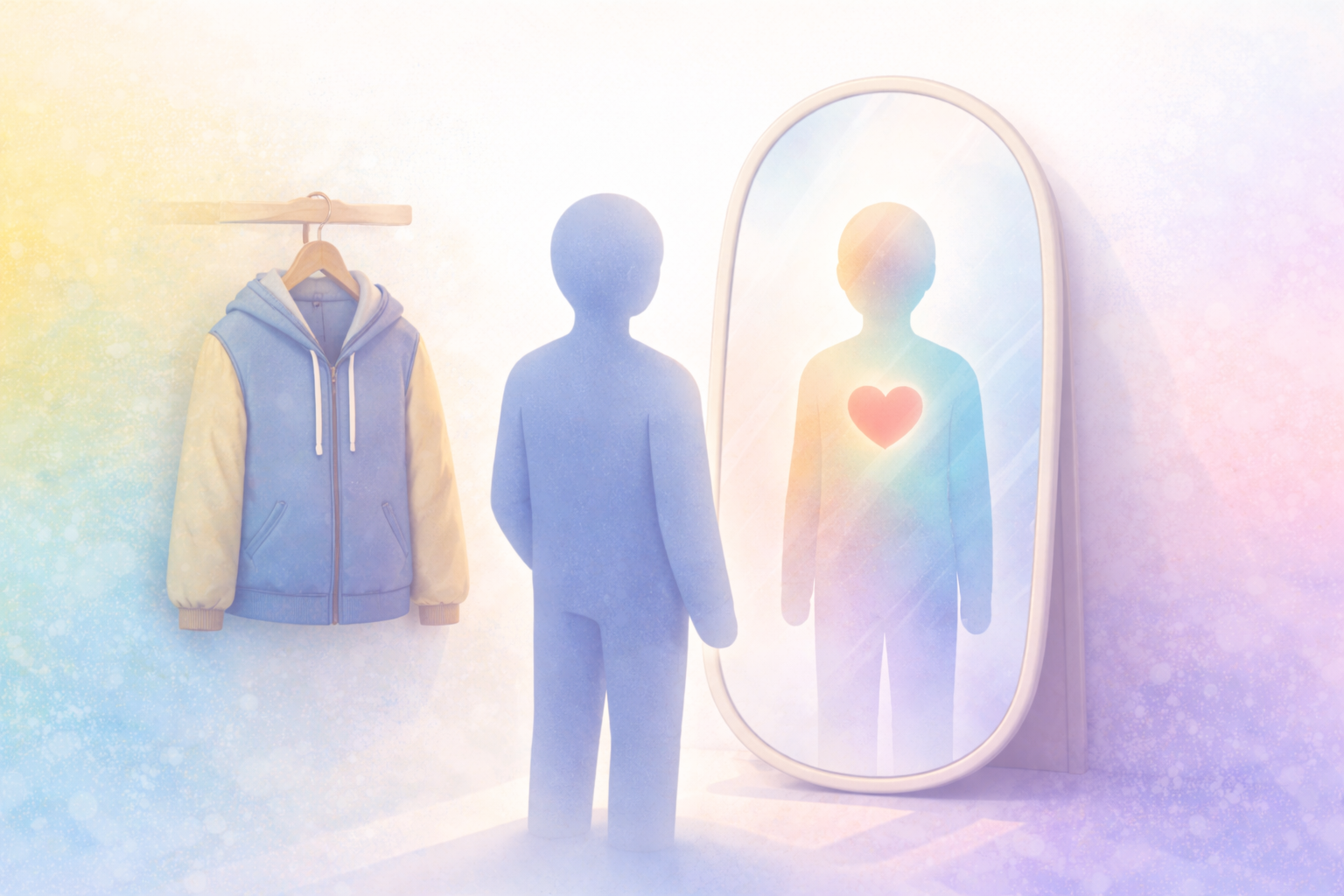
In Georgia, gender is often tightly framed. People notice how you dress, how you speak, how you sit, what you study, what jobs you choose, what emotions you express — and often quickly conclude: “That’s masculine” or “That’s feminine.”
This is what gender expression is : the behaviors or choices a person makes that society associates with a particular gender.
Gender expression can include:
- Clothes, hairstyle, makeup (or lack of makeup)
- Voice, gestures, body language
- Hobbies and social roles
- How a person wants to be perceived in society
Some expressions are perceived as “masculine”, some as “feminine”, and some as mixed or neither at all.
Gender expression does not necessarily have to match gender identity. A person can express themselves in a way that society considers “feminine” and still be a man, or they can express themselves in a “masculine” way and still be a woman. A person can be non-binary and choose any style.
Society teaches us “shortcuts”:
- “Long hair = woman”
- “A loud voice = a man”
- “Makeup = Feminine”
- “Strong and silent = masculine”
But these are simply cultural habits, not laws of nature. Moreover, these rules change from place to place and from generation to generation.
“What Should I Do If I’m Confused by Someone’s Gender Expression?”
When you’ve grown up with strict expectations, this is a perfectly normal reaction. Confusion is not a crime. The problem begins when confusion turns into ridicule, harassment, or “I’ll show you how to be.”
If you are not sure, but want to show respect:
- Don’t make comments about your body or appearance;
- Use their name;
- If it is necessary to use a pronoun (for example, in English) and you are not sure, ask politely;
- Avoid jokes about “real men” and “real women.”
► Remember: To treat someone humanely, you don’t have to completely understand their identity or their style.
Transition — What It Means and What It Doesn’t Mean
When people hear the word “trans,” many immediately think of surgery. This is one of the most common misconceptions.
Transitioning means taking steps to make your life more consistent with your gender identity, but there is no one “right” way to transition, and no one person has the responsibility to “prove” anything to the world.
Different people transition in different ways, depending on what feels right and safe, what is financially available, and what opportunities exist in their environment. There are three main types of transition:
Social transition refers to how a person lives their daily lives. It can include:
- Using a different name
- Using other pronouns
- Changing your hairstyle or clothes
- Telling friends, family, and colleagues how to address and refer to you
For many, social transition is the most important step because it is directly related to daily life and dignity.
Legal transition may include, for example:
- Changing the name on documents
- Changing gender markers (where permitted by law)
Such legal steps are significantly dependent on local laws and bureaucracy.
When it comes to medical transition, this can mean:
- Hormones
- Operations
- Other gender-related medical care
Some want medical transition, some don’t. Some prefer small changes, some bigger ones. And some, despite their desire, cannot receive this help due to lack of access.
► Surgery does not involve “sex change.” Sex is determined by many factors other than genitals and is a biological fact that cannot be changed. Surgery is gender affirming — changes that bring the body more in line with a person’s internal gender identity.
“Why Doesn’t Everyone Undergo Medical Transition?”
There are many possible reasons for this:
- Health reasons
- Price and availability
- Fear of discrimination or violence
- Family or work pressure
- Living in a place where it is not safe
- Or simply a lack of desire
Security and social pressure are often very real factors in Georgia. So it is especially important not to assume that we know exactly who “should” be doing what.
Most importantly, no one is obligated to transition in any particular way. For a person’s gender identity to be real, they do not need to take hormones, have surgery, have a specific look, or “prove” anything to society.
Sources: The Trevor Project, Amnesty International, IMGender, Brook