


In May 2011, the first international instrument was signed in Istanbul, establishing a broad legal framework against violence against women and introducing much deeper and more comprehensive approaches. The document, known as the Istanbul Convention, was signed by 45 states and the European Union before Turkey, the first state to ratify it, decided to become the only country to do so. Latvia is the only EU member state to have initiated the process of revoking its ratification of the Istanbul Convention, although it has so far been put on hold amid backlash.
The Convention aims to protect women from all forms of violence, to eliminate it and to take necessary measures to prevent domestic violence. It also aims to reduce all forms of discrimination and to achieve real equality, including through the empowerment of women.
To achieve this goal, states were tasked with developing a comprehensive framework and setting policy in a way that would facilitate international cooperation, while helping non-governmental organizations, women’s rights activists, and government agencies work effectively and in a coordinated manner.
The state undertakes , on the one hand, to carry out informational and educational activities, to take care of promoting the personal development of perpetrators of crimes, to establish appropriate infrastructure and services to support victims, and at the same time, to call on and facilitate the private sector to take steps to achieve equality. In addition, to conduct statistics and public surveys in order to identify trends. The signatories to the Convention aim to transform social and cultural patterns of behavior in such a way that substantial equality between women and men is possible.
Recently, invited to a debate on the propaganda TV company “Imedi”, Zura Makharadze, a member of the violent “Alt-Info” and “Conservative Movement”, said that Georgia’s ratification of the Istanbul Convention has become a mechanism of ideological struggle and a means of transforming the traditional roles of women and men. He also believes it is the cause of the decline in the birth rate and cannot understand why the country is still a part of the convention.
In response, the Prime Minister of the Georgian Dream government, Irakli Kobakhidze, stated that “if there are question marks regarding the Istanbul Convention,” they are ready to work on this issue.
This recent discussion demonstrates the need to remember why the adoption of the Istanbul Convention became necessary, what its role is in preventing violence, protecting victims, striving for equality in society, and properly punishing and rehabilitating perpetrators.
Why Was It Necessary to Develop the Istanbul Convention?
According to the Convention, “violence against women is understood as a violation of human rights, a form of discrimination against women, and includes all acts of gender-based violence that result in, or are likely to result in, physical, sexual, psychological or economic harm or suffering to women, including threats of such acts, coercion or arbitrary deprivation of liberty, whether occurring in public or private life.”
Domestic violence refers to all acts of violence committed within the family environment, regardless of whether the victim and perpetrator live together or not. In addition, the Convention also includes gender-based crimes, which means that violence committed against women on the basis of their gender must be identified and that it has a disproportionate negative impact on them.
▶️ The signatory states condemn all forms of violence against women and domestic violence and recognize a number of challenges, including:
- The need to ensure equality as an essential element in preventing violence against women;
- the historical context of inequality;
- The structural nature of violence, which forces women to be in a subordinate position compared to men;
- A number of forms of violence that are predominantly directed at women, be it sexual harassment, rape, forced marriage, crimes committed in the name of honor, or others;
- The particular impact of armed conflicts on the increase in violence against women;
- The special impact of domestic violence or gender-based crimes on women and children.
And based on all this, states “strive to create a Europe free from violence against women and domestic violence.”
Keti Bakhtadze, a lawyer for the Women’s Initiatives Support Group, tells us that what was particularly important, and why the adoption of the Istanbul Convention was necessary, is that the state was tasked with implementing a comprehensive approach, not just punishing the perpetrator.
“The Convention declares violence against women and domestic violence as a violation of human rights and states that punishing the perpetrator is not sufficient to fully fulfill the state’s positive obligation. It is necessary to prevent violence and cooperate with various actors in this direction. The Convention also recognized that violence against women and domestic violence is a structural problem, where women are victims of historically established inequality,” explains Keti Bakhtadze, and tells us that it was no less important that the document introduced a conventional, legal definition of gender for the first time.
According to the Convention, “gender refers to the socially constructed roles, behaviors, activities, and characteristics that a given society considers appropriate for women and men.” Accordingly, the legal document has made visible the social arrangement in which the roles of women and men are defined and in accordance with this representation, demands are made, punishments are imposed, and benefits are distributed, which makes it difficult to achieve substantive equality.
The Convention envisages planning of protection and support measures in such a way that:
- Be based on a gender-based understanding of violence against women and domestic violence and focus on the human rights and safety of the victim;
- be based on a comprehensive approach that takes into account the relationship between victims, perpetrators of violence, children and the wider social environment;
- Aim to prevent secondary violence;
- Aim to empower and economically independent women victims of violence;
- Allow, where appropriate, for different protection and support services to be located in the same building;
- Take into account the specific needs of vulnerable persons, including child victims, and be accessible to them.
According to Keti Bakhtadze, another important aspect is that it calls on states to cooperate, imposes responsibility, collaborate, share experiences with each other, implement best practices and research the issue, prepare comprehensive statistics and plan state policy in such a way that it takes into account the gender dimension.
It should also be noted that when implementing the provisions of the Convention, in particular when adopting protective measures, discrimination on any grounds “such as sex, gender, race, colour, language, religion, political or other opinion, national or social origin, association with a national minority, property, birth, sexual orientation, gender identity, age, health, disability, marital status, migrant or refugee status or any other basis” must be excluded.
According to one of the provisions of the Convention, the implementation of the Convention is monitored by a group of independent experts (GREVIO), which is composed of representatives of member states and includes 10 to 15 people.
Georgia and the Istanbul Convention
Georgia became a signatory to the Istanbul Convention back in 2014. The document was signed in Strasbourg by the then Minister of Justice, Tea Tsulukiani. Already in 2017, Georgia ratified the Istanbul Convention, that is, the state declared the international treaty a binding document. The parliament was unanimous in ratifying the agreement — 85 in favor and none against. Georgia remains the first and so far the only state in the region to ratify the document. This step, which was supposed to bring its legislation into line with the Convention, was part of Georgia’s commitment, which implies sustainable development.
A press release issued by the Georgian Ministry of Foreign Affairs in 2017 regarding the ratification of the Istanbul Convention stated: “It underlines the great importance the country attaches to the protection of Council of Europe values such as human rights, the rule of law and democracy.”
According to Keti Bakhtadze, the ratification of the document brought about systemic changes, which made it possible to significantly improve the situation in the protection of women’s rights.
A huge legislative package was prepared, I would say unprecedentedly large, which introduced systemic changes to numerous legislative acts. This did not only affect the law on violence against women and domestic violence, but also almost all documents that should systematically respond to violence against women and children. A different approach was established, our Criminal Code previously included many incorrect and inconsistent norms with international standards, which were revised, however, challenges, of course, remained.
Lawyer Eliso Rukhadze, who has worked on numerous cases of violence against women, particularly highlights the changes related to providing compensation to victims.
According to the Convention, if the perpetrator or other source of violence is unable to compensate for the damage caused, the state undertakes to provide financial support to the victims.
According to Rukhadze, after the ratification of the Convention, a number of protection orders have been based on the reservations there, and a definition of rape in accordance with the Istanbul Convention has also been requested, which in some cases the court has not found, although the prosecutor’s office has shared the blame. In addition, he said, the Convention also provides important leverage in supporting children who witness violence.
“Thanks to the convention, children who witnessed violence became visible and, in fact, equal to children who were subjected to violence. These children, if recognized by the prosecutor’s office as victims, had the opportunity to receive compensation for damages, both in cases of femicide and domestic violence against them,” Rukhadze tells us, adding that after 2017, perpetrators were practically no longer offered plea agreements.
He cites the creation of a specialized center for child victims of sexual abuse as another example of the benefits brought by the Istanbul Convention.
Although the ratification of the Istanbul Convention has created significant opportunities and leverage for the full harmonization of legislation with international standards, both Keti and Eliso note that a number of challenges still exist, and in other cases, regression has been observed in recent years.
One example is the discussion of rape cases in relation to violence and physical injury and the failure to take into account the circumstances that suppress the will and the absence of consent. According to Keti, significant challenges remain in the area of prevention as well. As a rule, the state should try to detect various types of violence before the situation escalates and leads to much more serious consequences, but this is not happening.
“The whole point of prevention is to immediately intervene in the behavior of the perpetrator and correct it. These programs should have been implemented. This obligation was also recognized by the law, although it has not been implemented yet.”
Keti Bakhtadze also draws attention to the fact that not all cases of intimate partner violence have been covered. For example, in the case of same-sex couples, because according to the law, the victim may be a woman or a family member, which does not take into account gay couples, and same-sex partners are not considered a family at all. In addition, she speaks about other areas where challenges remain.
“Our legislation fails to respond to the so-called “dating violence,” or certain forms of violence related to dates. It may fail to respond, including to violence committed using technology, which, according to the Istanbul Convention, is much more fundamentally formulated, including how the state should respond to this challenge. It should also be noted that our law does not see trans women as women, especially now that the law focuses on genetic characteristics. However, the Convention directly states the need to eliminate gender discrimination,” — notes Keti and adds that the existing changes are not enough, including shelters.
“The Istanbul Convention says that it is better for shelters for protection from violence to be in the hands of non-governmental organizations. Because, as studies show, victims have more trust in organizations working on issues of violence against women than in state shelters.”
In fact, the Istanbul Convention directly states that the coordinated work of non-governmental and governmental structures is of crucial importance:
“The Parties recognize, encourage and support the work of relevant non-governmental organizations and civil society at all levels that are actively combating violence against women and establish effective cooperation with these organizations.”
Given this reservation and the fact that the Georgian Dream party has adopted a number of laws in recent years to restrict and completely ban NGOs, we asked respondents to assess how much space and opportunity there is left for cooperation. Both unanimously note that the state is no longer oriented to continue coordinated work in this direction.
“The situation in this direction is very difficult. For years, government agencies and women’s rights activists have been at a standstill, and there is practically no way out,” Eliso tells us, while Keti notes: “ The activities of non-governmental organizations are criminalized, and while the state has previously taken responsibility and done the work under our supervision, in cooperation with us, with our involvement, we were not given the opportunity to continue this, and the cooperation has ceased.”
Eliso Rukhadze considers the issue raised during the debates on Imedi concerning the revision of the Istanbul Convention to be disturbing and alarming. She believes that if women have previously had the opportunity to report violence and hope for protection from the state, even through force and fear of internationally assumed obligations, for them and their children, the possible cancellation of ratification will lead to the revision of a number of articles and we will return to the previous level of protection and empowerment of victims.
According to Keti Bakhtadze, given that we have been witnessing the most serious crimes committed in recent years by law enforcement agencies, be it torture, inhuman treatment or other, it is clear that a human rights crisis is already underway in Georgia. Therefore, even with the Istanbul Convention in place, she does not expect women’s rights to be a priority.
“If we do not cooperate with GREVIO, if steps are not taken to enable NGOs to work together with relevant agencies, if the repressive legislation against us is not repealed, we will not be physically able to fulfill the spirit of the Istanbul Convention.”
We have mentioned a number of reasons why international monitoring of violence against women and domestic violence is necessary, of course, taking into account that men can also be victims of violence (this is also clearly stated in the Istanbul Convention). However, in any case of violence, women are mostly the victims and men are the perpetrators, so it is necessary to see the problem from a gender perspective and work to eliminate it.
Specifically in the case of Georgia, in 2025 alone, the motive of “gender/intolerance of gender equality” was identified in 798 criminal cases, of which 788 cases involved a male defendant. The “gender intolerance motive” was identified in 1,192 cases of criminal cases of violence against women and domestic violence in 2024, of which 1,172 cases involved a male defendant.
For example, around one in three women worldwide is a victim of physical or sexual violence. In the European Union alone, 95% of all cases of trafficking for the purpose of sexual exploitation are women, and women are the world’s most vulnerable to genital mutilation. It should also be noted that the EU’s gender equality index has been slowly but steadily improving from 2013 to 2024, with a five-point increase from a maximum of 100 to 70.2 points.
As for Turkey, the only country where ratification was revoked, the situation of women’s rights has been dire for years. For example:
- The last, largest study was conducted ten years ago, which showed that 40% of women had experienced physical and sexual violence, but only 10% of them sought support services.
- According to a 2018 study, in which 1,481 women were interviewed, 41% had experienced domestic violence, and 89% of these cases were perpetrated by a male partner.
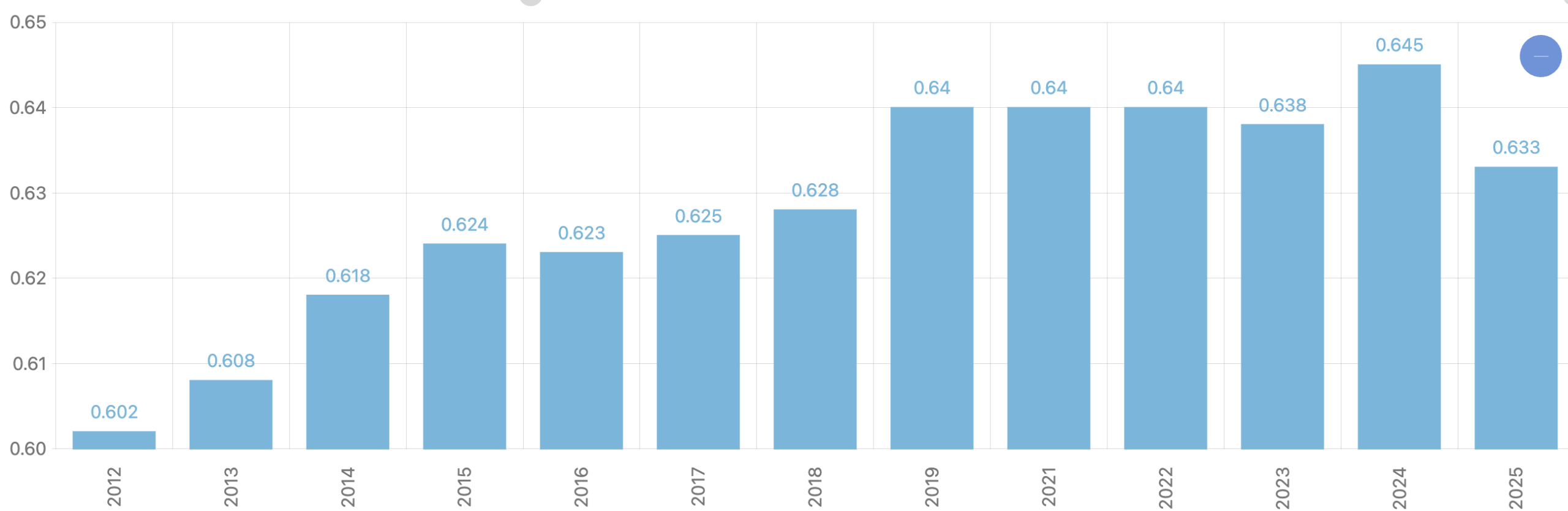
In Turkey, the ratification of the Istanbul Convention has transformed the legislation in such a way that the gender dimension of crimes has become much easier to observe. Although challenges in implementation have been noted in several reports, progress has been clear. It is also emphasized that after the withdrawal of ratification, the legislative changes in the country have remained, although the international monitoring mechanism has been abolished, which has been accompanied by increased political rhetoric in recent years, referring to conservative gender roles.
The gender gap index (this data is not as comprehensive as in the case of the European Union and cannot cover the absolute equality indicator) was characterized by small delays, variable, but slowly increasing dynamics. This increase was maintained until 2024, and in 2025 it reached its lowest level since 2019.
Across the world, to varying degrees, there is a growing rhetoric that emphasizes the importance of social and cultural change by referring to prevailing gender roles. In addition to the rhetoric, it is worth noting the results of a recent survey, according to which Gen Z men are the first generation after the late boomers to have the highest perceptions of conservative gender roles. Also, despite the sharp imbalance in the workforce, household labor, economic opportunity, political participation, and the sharp disproportion of crimes committed against women and men, 60% of Gen Z men think that the idea of gender equality is discriminatory against men.