

“If I had an abusive husband, I wouldn’t be able to go anywhere,” says a young woman who was left with no material possessions from her family, as everything was divided among her brothers. She is not the only one who has had a similar experience. Moreover, she is one of those people who was told that she had to make her own way in life or join her husband’s family, while her parents’ house, car, and land, which by law belonged to all children, were left only to the boys.
In this article, we will discuss the unequal distribution of inheritance in Georgia — a vicious practice that creates unequal conditions for children simply because they were born as girls. We will discuss the barriers a woman faces when her parents or brothers decide to take away her property because she does not have the status of “carrier” in the family.
“The brothers have a country house and 9 cars, I have nothing”
Maya [name changed] grew up with her mother after her parents separated. She spent most of her time in the village with her grandparents, who, before moving there, left all the real estate they had in and around Tbilisi to Maya’s uncle, her mother’s brother. According to her, the property was quite large — houses in the suburbs of Tbilisi, a village house, and land.
“It was a very common occurrence. If I told you that someone was heartbroken and someone was surprised about it, I would be lying. I thought all my life that it was very normal, just like my mother, just like my mother’s mother — it was accepted practice, no one protested for a moment.”
With the approaching winter, Maya’s grandparents would come to her mother’s house. Maya was a student at the time. Due to the lack of living space, she had to sleep in the living room herself. Years later, when her grandparents could no longer live independently in the village, there was no question of them moving in with them.
Looking back , Maya believes that inequality was present here as well — her uncle took no part in caring for her elderly parents, and he did not invest either emotional or financial resources in it. He said he did not have the means to do so. Neither did Maya and her family, but they took out loans and tried to make ends meet.
She recalls how her uncle had his parents transfer everything to his own name:
“When my uncle told me that my grandparents were already ill and might not have long to live, he immediately took them to the courthouse and had them register the two plots of land and the house. But not by force, we knew that this was how it had to be, he simply accelerated the process — since they had been living with us all along, he probably thought that we could influence them.”
Later, grandfather revealed to Maya’s mother that he was very saddened by what had happened.
“My grandfather himself told my mother, ‘I shouldn’t have done this, it’s not fair, I’m putting a burden on your children and I am not doing anything for your children. But he had done so much for us in an intangible way, he was truly a father to all of us, that no one would have felt that way. In the end, it still came down to a conflict, but not about dividing the property — we sincerely asked him to simply get involved and participate in taking care of the dying people, his parents.”
Grandparents died 3 years apart. Maya’s uncle now owns the entire estate they left behind.
“He says, come whenever you want, the key is there and everything, but we don’t want to go there anymore. Besides, the house has been closed for so many years, he doesn’t take care of it himself, he doesn’t care, he says, ‘I don’t have the means to look after it.'”
Maya attributes the fact that her mother never claimed her share of the inheritance to her upbringing and discriminatory stereotypes, according to which the boy is the “superior” child in the family. She believes that this perception existed in her family as well.
“My mother herself was raised in such a way that even if she told a thousand people, ‘It belongs to you and you can express it, you have the right to do so,’ she would never show initiative. These are the people who put ‘what people will say’ ahead of their own interests. That’s how they grew up, and then that’s how they raised us too.”
This is connected to Maya’s mother’s refusal of her grandfather’s offer, when he told her that he could change his mind and leave part of the estate to her.
Years later, like her mother, Maya herself experienced unequal treatment simply because she was a girl child.
She recalls that her father’s financial situation allowed him to build a country house for his children. And it happened so that the construction of a huge country house began, but with one reservation – the house would belong to Maya’s brothers.
After some time, the house was sold, but Maya’s grandparents made sure that Maya’s brothers were not left without property. It was decided that the father’s parents’ house would go to one of the grandsons, and Maya’s mother’s house to the other. Maya was again not included in this plan.
“My father had a house at certain intervals, sometimes he didn’t, sometimes he had a lot, sometimes he had a little, but I never had any, including not only a house, but also cars. He bought several cars for one boy, 9 cars for my brother, and I bought my car with my own money and a loan. I was already married, had a child, and needed it for work.”
“I didn’t get anything from anyone, neither from my father nor from my mother. If I have anything, I bought it all myself.”
Maya thinks that if she had taken care of her mother to protect her rights years ago, she would now be motivated to demand what is rightfully hers. She still talks about this issue with her mother and relatives today — sometimes jokingly.
“I often say that if I were to divorce my husband today, I would have no alternative accommodation. I would have to rent an apartment or live with some woman temporarily, because I have nowhere to go. If I had an abusive husband, I would have nowhere to go. My mother’s response to this is that this house is yours too. She is talking about the house she lives in with my brother. For as long as I can remember, this house was my brother’s and now it is somehow mine too. No matter what happens, I will not come here and say that it is mine.”
“They Realized I Wouldn’t Back Down”
Keta [name changed] is 26 years old and lives at home with her mother and her brother, who is 3 years older. Her father died a few years ago. She was in danger of becoming homeless when her brother decided to start a family.
“He announced that he wanted to buy another house and no longer wanted to live with us, which was physically impossible, given that we live in a fairly small house. He said that we should sell the house we live in and give him the money, with which he could then buy a bigger house.”
According to Keta, the future plan, which the family members made without her participation, provided that her mother would move to the village, and she was left with an artificial choice — to live with her brother’s future family or “to think of something else.” In Keta’s words, this directly meant that she would be left homeless.
“They didn’t take me into account at all in this plan, nor my interests, what I planned to do in life, or whether I wanted to live with new people. No one asked me anything about it, they directly informed me of the decision. My mother was the mediator between us, she didn’t come herself and directly say: I’m doing this, what do you think? They didn’t even ask me to share my opinion, they directly decided.”
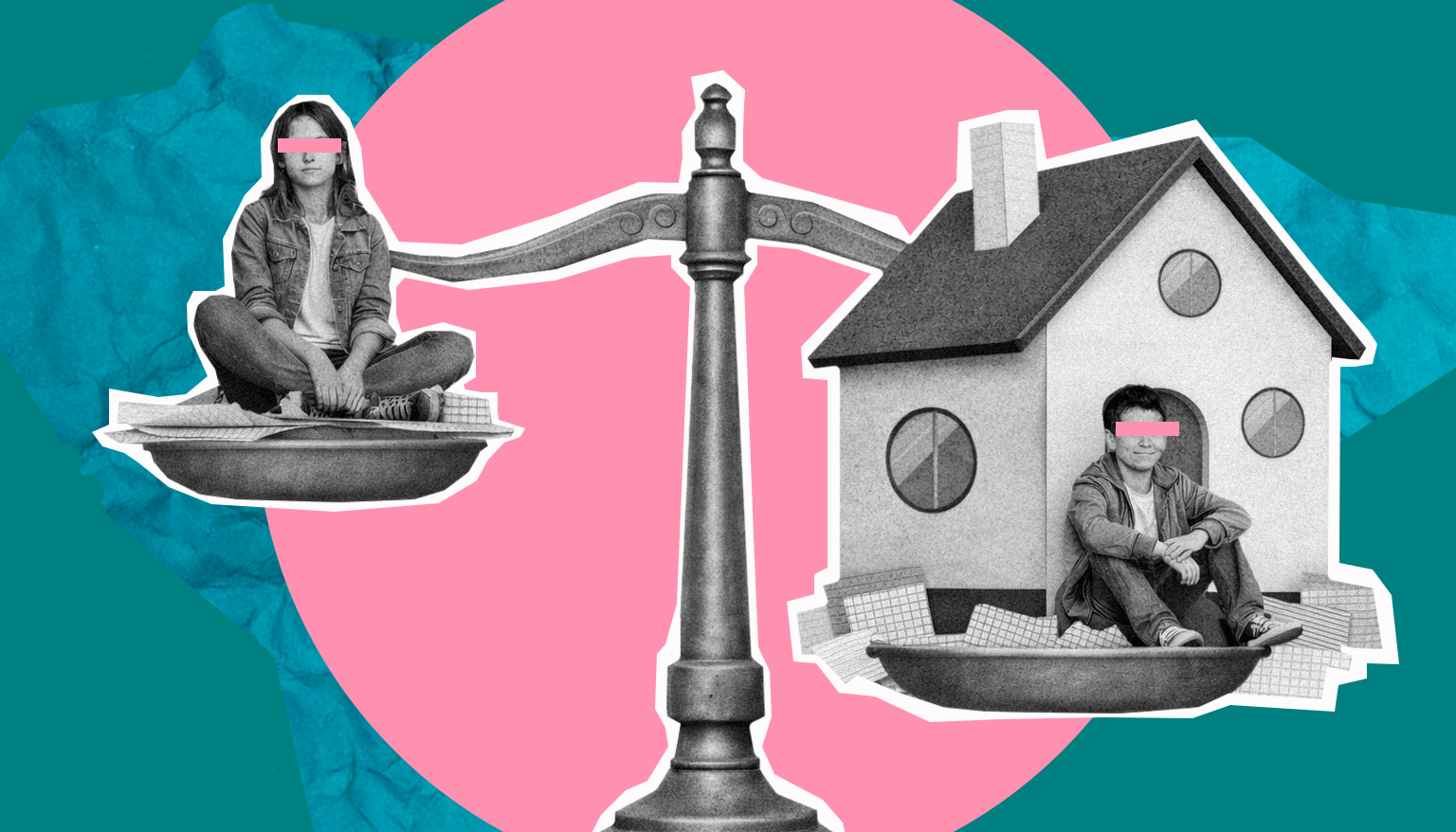
This news was shocking for Keta. She did not expect that the issue of selling the house would ever arise. She could not even imagine that her interests would be completely ignored. She was left with the feeling that her brother’s opinion and life were more important to the family members. Although she herself did not want to live with her mother and brother, she could not afford to move in with a renter. She says that even if it were not so, it would be unfair for the house to belong only to her brother, and she continued the fight — first of all, she told her family members that she did not intend to accept the proposed “choice”, which led to disagreements and arguments.
“My brother didn’t expect me to have my own opinion and plan. He didn’t expect that I might not want to participate in someone else’s future. He didn’t say it outright from the beginning, but it was already clear why he didn’t expect it — because I’m not married, I don’t plan to get married, and I don’t have any such prospects in the near future. It’s not part of my immediate plans.”
“My brother thought that as a married man, he had more “sayings,” more rights, both as a man and as a brother; that he had the right to decide where and how I would live and to benefit in every way from the small fortune my mother had.”
Unfortunately, the conversation did not yield any results, so Keta had no other choice but to tell her family that she was taking legal action. She believes that this decision made them realize that she was not going to back down.
This is not the only case where a young woman has had to fight for her share and property. After her father’s death, the family was left with a small plot of land in the village. To find out the details of the transfer, her mother and brother went to the notary, where he explained that according to the law, it should be divided equally between the children. Keta later learned about what happened there from her mother:
“My brother started a fight there and told the notary that I didn’t own anything. I was allegedly refusing to transfer the plot of land and he had to approve it because his plan was to sell the plot and take the money. The notary told me that this doesn’t happen, that it’s not allowed by law, and it’s impossible for him to just stand up and transfer all the property to my brother without my actual verbal or written consent.”
According to Keta, after her brother learned that he no longer had the opportunity to own the entire land, his interest in his father’s property completely disappeared.
Law That Is Ignored
Many women in Georgia have shared and continue to share this experience. The topic remains taboo in society to this day. The scale of the problem was clearly demonstrated in 2021 in the Facebook campaign “I am a heiress too” by the women’s rights organization Sapari, which gathered numerous stories in which women spoke out, mostly anonymously, about how they were left without shelter simply because they had a girl child in their family:
"My father has businesses all over the region, and when they say my family has so much money, they don't know where to take it. But both my mother and father keep telling me that I have to leave home and my husband's property will be mine, that I don't own anything else from them. My father told me that's all I need, he said: you should have both your husband's property and mine together."
"I was the second child in the family, after my sister. When my father found out that I was a girl, he told my mother to leave me in the maternity ward, but I looked so much like my father that he changed his mind. A third brother was born. My father and mother always distinguished me and my sister from my brother. My brother always had to have the newest everything. They fulfilled all his wishes, sent him to private school. My grandfather left me a house in the village for my sister and me. My father sold this house to pay for my brother's university education. When my sister got married, she didn't have a house for years and lived in a rented house."
And, what does the law say?
According to inheritance law: “The estate is divided equally among heirs of the same rank. In this case, there is no difference between the rights of the heirs with respect to the inherited property. In the event of disagreement between the heirs on the division of the estate, the dispute is resolved by the court.”
Why is it that Georgia’s inheritance laws rarely align with the vicious practices that exist in our country regarding the distribution of property? Why do women have to fight to get what is legally theirs?
In fact, gender-based privilege does not only begin when it comes to property division. Often, this is felt from the moment of a child’s birth and manifests itself at various stages of upbringing. We often hear that a boy is referred to as the “continuator of the family name,” while a girl’s main role is seen as taking care of her parents when she reaches adulthood — and this is often the case. In addition, girls are raised from a young age with the feeling that they are “temporarily” in their parents’ family, because after marriage they will have to leave home.
The report by the Center for Social Justice, which reviews the gender aspects of inheritance distribution in Georgian culture, notes that the problem of gender inequality in Georgia is clearly manifested in the practice of unequal inheritance distribution.
The document states that this is one of the most important, yet least studied forms of economic violence and discrimination against women. The Law of Georgia on the Prevention of Violence Against Women and/or Domestic Violence, Protection and Assistance to Victims of Violence defines economic violence as “actions that result in the restriction of the provision of food, housing and other conditions for normal development, the exercise of property and labor rights, as well as the right to use and dispose of jointly owned property,” although due to stereotypes rooted in society, the unequal distribution of inheritance is often not perceived as violence.
“Unequal distribution of inheritance based on gender differences, as a form of economic and structural violence, is not understood and recognized by society. Liberal legislation in Georgia allows women and men equal access to parental property, however, despite this, cultural norms and traditions are so strong that women are largely left without inheritance. Women often do not consciously exercise their right to inheritance or are not even aware of the existence of these rights.”
In addition to the fact that women have to fight and overcome numerous obstacles to receive inheritance, this unequal, vicious practice creates another significant problem – in some cases, women may be prevented from escaping domestic violence precisely because they do not have a place to live. As a result, many women are forced to live with abusive husbands or partners, which puts their lives and health at risk.
In the Social Justice Center report, some respondents said that they asked their parents to help them rent or mortgage an apartment, but they could not force them to do so unless they were willing. In addition, some women believed that in the event of divorce for various reasons, including violence, it is the husband’s family’s responsibility to provide housing for them and their children, not the woman’s parents.
"I would try to resolve it peacefully and for me to go somewhere peacefully. This problem happens, and the woman is holding back precisely because she has a brother and so that she doesn’t have to deal with it [woman, 29 years old, with higher education, employed, living in emigration].
[The woman] should return to her parents' house. She shouldn't demand [a share]. If the family can afford it, then yes, but not if not, fine. If they can afford it and still don't buy it, that's up to them, I don't know. I really don't know what I would do. [Woman, 33 years old, with higher education, employed, married, Kutaisi].
It is also worth noting that if a woman claims her share, part of society perceives this as a betrayal of traditions and family. Accordingly, this is followed by criticism, reproach, and sometimes even insults. Given all this, it is often unthinkable for women themselves to gain the right to their property through the courts. Research by the Center for Social Justice also revealed that sisters avoid spoiling their relationship with their brother and say that they would not sue in court because they have a “different” sibling. In some cases, women, despite being dissatisfied with their parents’ decision to distribute the inheritance, still consider it unacceptable to sue in court and would not do so even if they received nothing from the family. These attitudes of women are ultimately tied to their upbringing and how they were shown their “role” from childhood. Breaking through this barrier usually requires a tremendous amount of effort and emotional resources.