

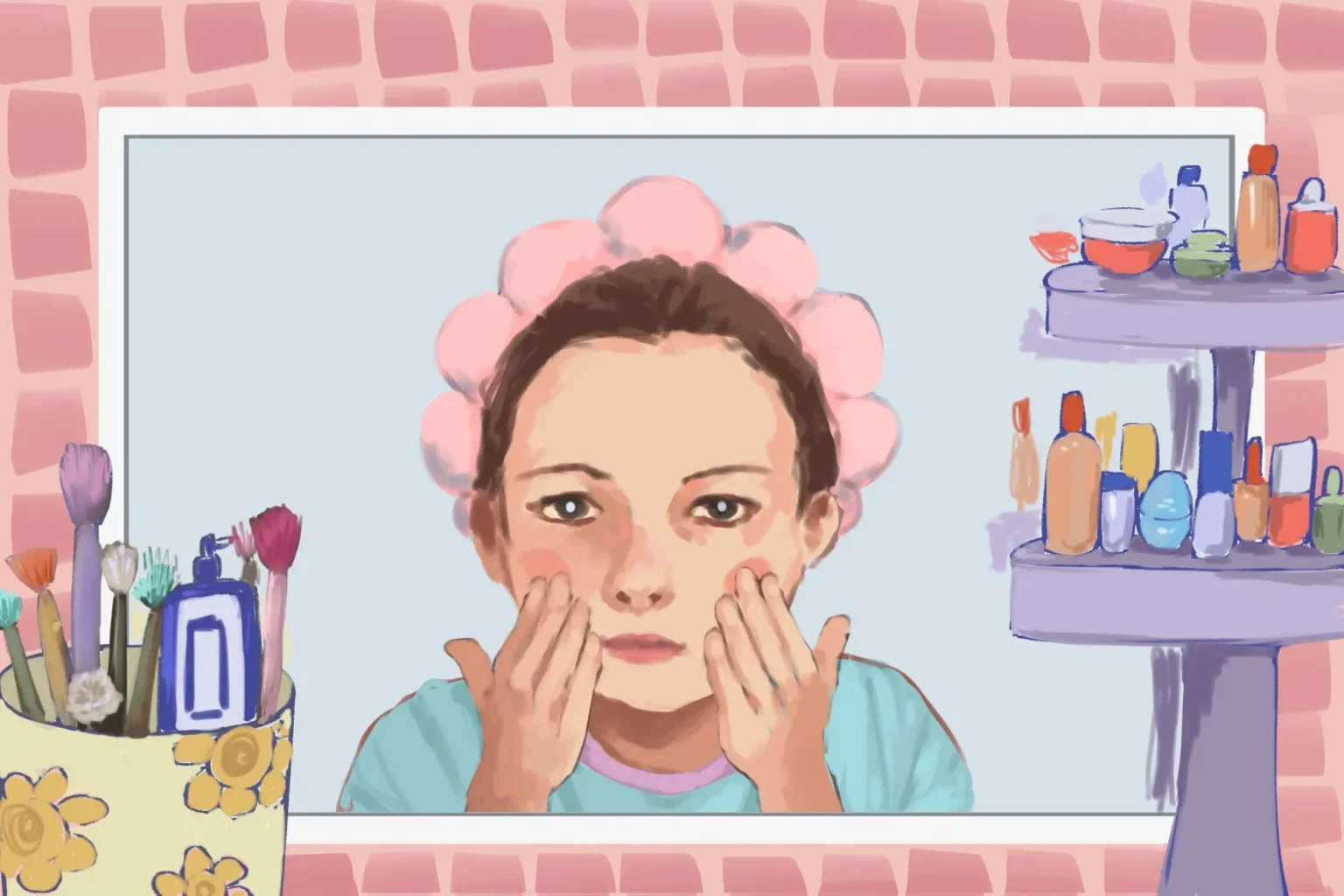
“Get ready with me to go to my best friend’s,” says teenage girl Ellie-May enthusiastically to the camera. This is how a long BBC article that the publication published on the growing, alarming connection between children and the skincare industry begins. Ellie-May is one of those who has found herself caught up in this market’s “trap.” At the time of the video, she was just 10 years old and shared her multi-step skincare routine with TikTok subscribers:
“I love this toner so much,” she says, applying the clear liquid to her face. Then it’s time for the serum, which adds radiance to her skin: “Oh my God, it’s so glowy!” Ellie-May exclaims in admiration.
Ellie-Mae is now 13 years old. She has been using and advertising her own skincare products since the Covid pandemic. What started as a fun and entertaining activity has now become the main source of income for her family. Facebook, TikTok, YouTube, Snapchat — Ellie-May has accounts on these networks, including 330,000 subscribers on TikTok alone. The girl’s mother, Sophie, says that they earn more than £50,000 a year by publishing content on various platforms.
As a search on social media shows, Ellie-May is not the only teenager involved in this industry. If you search for children, hair or skin care on social media, you will find hundreds of similar videos of children (sometimes as young as 3-4 years old) and teenage girls from many countries around the world. They are also called “Sephora kids”.
A small study conducted by skincare brand Pai among 1,500 teens ages 9 to 12 found that nearly half of those surveyed use multiple skincare products on a weekly basis. And half of that group said they use these products to address issues they believe their skin has.
So-called Cosmeticorexia — the Pressure of the Beauty Industry to Rejuvenate
“Women in their 30s and 40s have long been the target audience for skincare companies. Brands constantly tell us that aging is a problem and then sell us ‘solutions’ to it. […] But now we’re seeing a dramatic shift. The same pressures that used to be directed at older women are now being applied to younger girls,” Brooke Erin Duffy, an associate professor at Cornell University and a social media researcher, tells the BBC.
“As this industry continues to grow, fueled by content shared on social media platforms, the question arises: is this simply harmless fun, or are girls being constantly conditioned to believe that there is something ‘fixable’ about their appearance? And what does this tell us about how teenage girls today perceive themselves?”
Dermatologists and researchers have even coined a new term — “cosmeticorexia.” They define it as a culturally reinforced, unhealthy obsession that begins at an early age with the desire to achieve “flawless” skin and manifests itself in the excessive or age-inappropriate use of cosmetic products.
From a psychological perspective, routines that focus on appearance as much as possible may increase excessive attention to imagined “flaws,” increase stress caused by comparison to others, and reinforce obsessive behaviors related to constant appearance control, purchasing cosmetic products, and “managing” one’s appearance.
Cosmeticorexia is not currently recognized as an official diagnosis, but dermatologists say the possible consequences of this phenomenon can be detrimental to both physical and mental health. For example, cosmeticorexia in teenagers can lead to damage to the skin’s protective barrier, skin irritation or allergic contact dermatitis, as well as the strengthening of obsessive behaviors related to appearance.
“Social media, marketing campaigns, and influencer posts often portray multi-step skincare routines as the norm, which contributes to early exposure to these practices and increased risks associated with them, especially among children and adolescents,” we read in the introduction to the thematic study.
Professor Giovanni Damiani, a dermatologist at the University of Milan, is one of the authors of the study. In his practice, the dermatologist noticed an increase in cases of irritant and allergic contact dermatitis on the faces of patients aged 8 to 14. He was so concerned by the behavior of his young patients that he began investigating the issue.
“These patients also exhibited noteworthy behaviors. For example, they refused to go out without makeup. They used excessive amounts of cosmetics or constantly watched videos related to skin care/cosmetics. Their interests changed radically, practically taking everything else to the back burner.”
After observing patients, Damian contacted Alberto Stefano, a clinical psychologist at the National Institute of Health in Rome, to study cosmetorexia (also known as “dermorexia” — a term first used by Guardian columnist Jessica Defino in 2023).
They interviewed 55 patients, whose ages ranged from 8 to 14 years old. It turned out that children with signs of cosmeticorexia were addicted to mobile phones and spent hours watching videos about skin care on social media. They used up to 10 different skin care products every day and avoided social interactions without makeup, even with family members.
According to Damian, the main goal of the study was to determine whether cosmetic correction in children and adolescents is associated with an increased risk of developing both body dysmorphic disorder and contact dermatitis.
Alberto Stefana is an Italian psychologist who also participated in the preparation of a scientific paper on cosmetic correction.
“Children for whom skin care becomes an obsession are largely guided by what they see on social media. Consequently, their self-esteem becomes dependent on how many likes they receive or what they write in the comments,” says the psychologist.
Since so-called cosmeticorexia is such a new phenomenon, it’s hard to say what potential long-term psychological consequences it could have. However, Stefana notes that her latest research shows some similarities to body dysmorphic disorder (BDD) — a mental health condition that causes persistent feelings of shame and anxiety over perceived “flaws” in one’s appearance.
The psychologist says that even at a very early age, 7-8 year old children with signs of cosmetic correction are already seeing signs of anxiety and embarrassment.
According to him, these feelings are sometimes so intense that “children don’t even want to go to school because they feel so much shame. And this shame comes from comparing themselves to others through social media. They think they’re not pretty enough.”
Stefana observes that children and young people spend a lot of time and money trying to achieve an image and aesthetic that only exists in the digital world and not in reality.
“Even the idea of what is attractive and what is unattractive is becoming distorted. Filters and the use of artificial intelligence (AI) in social media posts mean that some of the images that children see are not even real. Consequently, they strive for things that do not exist in nature at all,” says the psychologist.
In addition to the many risks, it is worth noting that skin care products are definitely not cheap. Cleanser, toner, primer, moisturizer, serum, eye cream, face spray — and all over again. This is how children, including elementary school students, try to achieve the Korean so-called glass skin effect.
“What’s the irony? They already have it – when you’re young, your skin is in perfect condition. […] The skin barrier, which keeps toxins out and moisture in, is perfectly preserved… That’s youth, that’s the beauty of the skin,” says BBC dermatologist Dr Jane Eyre, who works as an NHS consultant and private dermatologist in Stockport.
Eyre, who has been practicing medicine for nearly 20 years, says that more children are using cosmetics than ever before. Her consultations vary widely: on the one hand, parents ask what kind of skin-care routine would be best for their young children, and on the other, she sees children as young as eight who have already developed severe reactions to the beauty products they have been using. Parents are often shocked, the dermatologist says, but they are unable to convince their children to stop using so many different products.
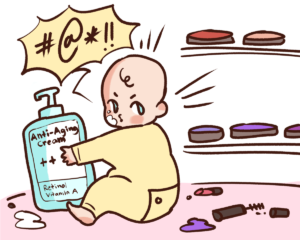
“This is concerning. […] These products are designed for the anti-aging market. At best, children don’t need them at all. At worst, the ingredients in the products can be harmful and damage delicate, young skin,” says Dr. Eyre.
She says she’s increasingly seeing young patients with acne and contact dermatitis, a type of eczema that develops after contact with a substance. She attributes this to the various ingredients in skin care products used by children.
Many of these products contain active ingredients that can biologically affect skin cells and change how they function. One of the most powerful is retinol, a substance that speeds up the skin’s cell turnover process and helps reduce fine lines and wrinkles in adults. However, this process is already occurring at a faster rate in children, so retinol may not provide any real benefits for them and may be overly irritating to the skin.
This can lead to what’s known as “retinol burn,” where the skin’s protective barrier is damaged. As a result, children may experience pain, eczema-like rashes, or long-term skin sensitivity. Dr. Eyre also warns that there are many other ingredients in these products that are potentially harmful to young skin. If a child develops a contact allergy to a substance, they may not be able to use a product containing that ingredient in the future without an allergic reaction, she says.
She says dermatologists are also increasingly seeing frontal fibrosing alopecia, a condition in which the frontal hairline recedes, in young people. Eyre explained that there is a small but growing group of researchers and specialists who suggest that it may be linked to starting skin care products at an early age.
Lower Self-esteem, Increased Anxiety and Depression — What Other Studies Show
Other studies have also shown that social media has a major impact on adolescents’ body image. Platforms like Instagram and TikTok, which focus on appearance, often promote idealized body standards, which can lead young users to adopt unrealistic ideals of beauty.
As adolescents seek recognition and validation through likes and comments, this process is accompanied by an increase in body dissatisfaction and negative mental health outcomes, according to a review of international studies published over the past five years using PubMed and Google Scholar databases. Key terms used in the search included “social media,” “body image dissatisfaction,” “mental health,” and “adolescents.” A total of 26 studies were selected for analysis.
Studies have consistently shown a strong link between frequent social media use and negative body image. Both male and female adolescents have reported increased body dissatisfaction, although most studies have focused on females. Social media exposure has also been linked to higher risks of eating disorders and an obsessive desire to be thin.
Frequent users of appearance-focused platforms experienced lower self-esteem, as well as increased levels of anxiety and depression, which were further exacerbated by the practice of comparing themselves to others (social comparison). Adolescents’ perception of their own bodies was further influenced by peer and parental validation, with peer approval playing a critical role in their self-perception. The negative impact of social media has been particularly exacerbated during the COVID-19 pandemic, which has been driven by increased isolation.
Another study showed that even watching videos on TikTok for less than 10 minutes can have a negative impact on a woman’s body image.
Researchers at Charles Sturt University surveyed 273 women aged 18 to 28 about their body image and beauty standards, then divided the selected group into two groups. Each group watched a different, eight-minute collection of TikTok videos.
One group watched content that glorified eating disorders (often referred to as “pro-anorexia” content). This material included so-called fitspiration videos, where women exercised and promoted weight loss methods. The other group watched nature, cooking, and comedy videos.
After watching the eight-minute video collection, both groups reported a decrease in body image satisfaction, but it was most pronounced among those exposed to the “pro-anorexic” content. They also showed a clear increase in internalization of unrealistic beauty standards.
The authors express concern that young women who view “pro-anorexic” content on TikTok are potentially at increased risk of developing atypical/disordered eating behaviors.
Dr Rachel Hogg, senior lecturer in psychology and co-author of the study, said the significant harm caused by even short periods of viewing content is of great concern for people who use the app for hours every day.
“It doesn’t take a lot of content consumption to have a negative impact,” he said. “We know that most people spend a lot more time on TikTok than our study participants.”
Social media, which places the main emphasis on appearance, is seriously damaging the psyche and perception of one’s own body, especially among adolescents. This fact makes it clear that it is not enough to just see the problem – action is needed. According to experts, the solution lies in working together: social networks must understand their own responsibility, adolescents must be taught to critically evaluate the virtual world and increase their media literacy, and parents and teachers must support adolescents and work together to mitigate the harmful effects of the online space.
Translated:
– From a BBC article. You can view the original version here.
– From an article in The Guardian. The original version can be found here.
– From an article in The Guardian. The original version can be found here.